The State of EDC, Late 2026: 6 Shifts Actually Changing What’s in Your Pocket
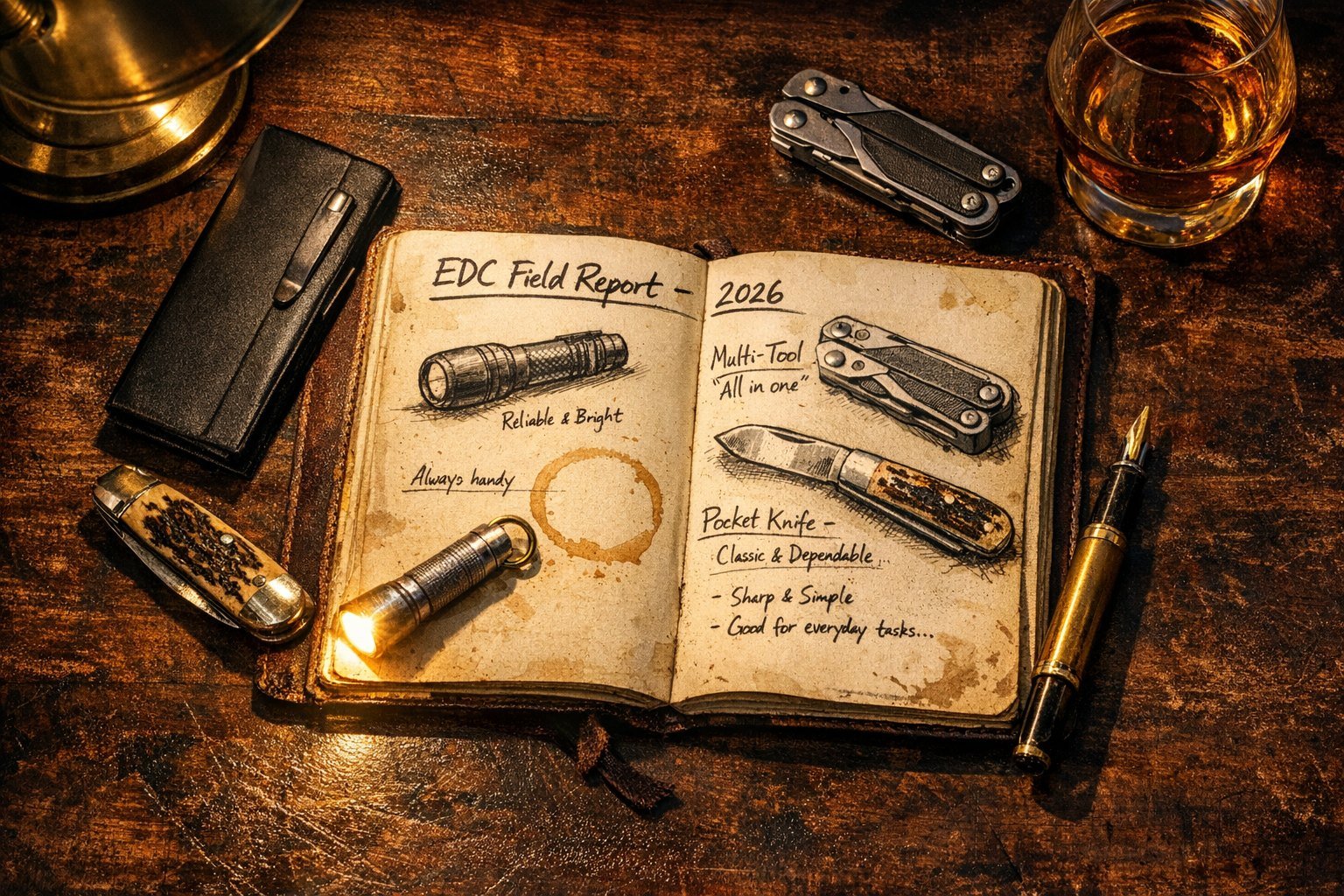
Every year someone declares EDC “over.” Every year the pocket gets more interesting instead. 2026 was no exception. Prices went up, locks got smarter, super steel showed up in places it never used to be, and the humble slip joint quietly made a comeback big enough to earn its own award.
This isn’t a buying guide. Think of it as a field report: six real shifts in what people are carrying, what’s driving them, and a few pieces of gear that show each one best. Whether you’ve got a drawer full of knives or you just keep a lighter and a flashlight on your keys, there’s something here for you.
Prices and availability below were checked on November 17, 2026. Holiday sales will move some of them.
1. The Price Squeeze Is Real, and Budget Gear Has Never Been Better
The headline story of 2026 isn’t a knife. It’s tariffs. Heading into the year, GSM Outdoors’ cutlery brand manager put it bluntly to SHOT Business: “We’re looking at a 50-percent tariff on imported steel.” When a knife’s main raw material gets that much more expensive, someone pays for it, and as he put it, “it’s like taxes.”
Here’s the twist. The same industry voices say that budget gear has never been better. Spyderco’s Michael Janich pointed out that changes in the steel industry mean even inexpensive knives now ship with performance that used to cost real money. Benchmade’s Vance Collver went a step further: well-made, affordable imports with premium materials are one of the biggest trends in the market, and “Made in the USA” is becoming less of a purchasing driver.
The judges at BLADE Show agreed. Their 2026 Best Buy of the Year went to the Kizer Drop Bear, a family that has kept growing. The standout this year is the Drop Bear Zero (list $129.95, often a bit under on Amazon), which has a screwless aluminum handle, a button-driven liner lock, and Elmax or M390 steel. A few years ago, that steel-and-lock combination meant a $250 knife.
If you want the clearest example of how good “cheap” has gotten, look at the Flytanium Pork Chop, released this month at $49.95. It has a 2.4″ sheepsfoot blade in 14C28N, contoured G-10 scales, an ambidextrous crossbar lock, and a deep-carry clip. Flytanium built its name on aftermarket upgrades, so it fits that there’s an S90V blade swap for $69.95 if you want to go further later.
See the Kizer Drop Bear Zero on Amazon · See the Flytanium Pork Chop on Amazon
2. Button Locks Won (and the Fidget Factor Is Why)
Ask anyone at a knife counter what’s moving, and you’ll hear about the button lock and the crossbar lock. CRKT’s VP of marketing told SHOT Business that both are now “common across the industry,” and every brand quoted in that piece mentioned the same thing in some form: fidget factor. People want a knife that’s satisfying to open and close, not just one that cuts.
It’s a real shift. Five years ago, most mainstream folders were liner locks or frame locks that needed two hands, or at least some care, to close. Now the default is a lock you can disengage with a thumb press, then let the blade drop shut. It’s safer for beginners and endlessly flickable for everyone else.
The best sign of how far this has gone is Spyderco. This is the company that more or less invented the modern pocket clip folder, and it has just released its first manual-opening button lock, the ButtonUp (about $72-78 street, $95-105 list). It’s an Eric Glesser design with a 3.27″ blade, carbon fiber/G-10 scales, and a ball-bearing pivot. When Spyderco follows a trend, it isn’t a trend anymore. It’s the new normal. On the newer end, WESN, best known for its minimalist gentleman’s folders, is taking a button-lock EDC knife called the Bok to Kickstarter this month.
3. Super Steel Is Trickling Down to Everything
A few years ago, CPM MagnaCut was the steel everyone on the forums wanted and almost nobody had. It’s very tough, very stain resistant, and holds an edge for a long time, and it was mostly found on custom and high-end production knives. In 2026 it started showing up everywhere.
The biggest example is the Leatherman Wave Alpha ($199.95), the most significant redesign of the Wave since it launched in 1998. It has a MagnaCut blade, the first on any Wave, plus a thumb stud for real one-handed opening, contoured G-10 handles in place of the old flat steel, and full-size spring scissors. If you’ve carried a Wave for years, this is the first version that’s a genuine reason to upgrade rather than a new color. MagnaCut also showed up this month on Filson’s collaboration with Swedish maker Casström, the No. 8 Swedish Forest Knife, and on Benchmade’s new $375 Bugout Vapyr.
Our take: premium steel isn’t a flex anymore. For blades you’ll actually use and sharpen, it’s quickly becoming the baseline.
See the Leatherman Wave Alpha on Amazon
4. The Slip Joint Is Back (It Got Its Own Award)
This is our favorite trend of the year. For the first time ever, BLADE Show added a Slip Joint of the Year category in 2026, and the inaugural winner was the LionSteel Barlow: a traditional pocketknife pattern that goes back centuries, rebuilt in Italy with M390 steel and handles ranging from carbon fiber to ram’s horn. Expect to pay somewhere in the $140-195 range depending on handle.
Why now? Part of it is a reaction to the tactical look. Not everyone wants a black G-10 folder clipped to their khakis. Part of it is practical: slip joints don’t lock, which means they’re welcome in more places. And part of it is the same reason a mechanical watch or a fountain pen still sells. Some things are nice because they’re old.
That’s always been the spirit around here. It’s why we still write about the Buck 110 and the Swiss Army Knife, and good to see the rest of the industry catching up.
See the LionSteel Barlow on Amazon
5. Keychain Lights Got Smart
The keychain flashlight used to be a single button and a single brightness setting. Not anymore. The Nitecore TINI 3 ($39.95) is under two inches long and weighs 0.71 oz. It puts out 600 lumens, lets you switch between warm, neutral, and cool light (3,000K, 4,500K, or 6,500K), and has a tiny OLED screen that shows your mode and battery level. It charges over USB-C, and an ultralow mode runs for 85 hours. Warm light matters more than people think: it shows true colors and doesn’t wash out the scene the way a harsh blue-white LED does.
At the other end, the flat “pocket brick” light keeps gaining ground. Olight’s new ArkPro Ultra ($129.99) packs four light sources into one slim aluminum body: a 1,700-lumen flood, an 800-lumen spot, UV, and a green laser. It’s a lot of light for something that rides in a pocket like a phone.
See the Nitecore TINI 3 on Amazon
6. Mashups and Modular Tools
The last shift is toward gear that refuses to be just one thing. The Oknife MK ($49.99) is a good example: a 300-lumen light, a 1.9″ slip joint blade, and a magnetic bit driver in one 52-gram tool, charged by USB-C with a AAA as backup. It’s the kind of thing that replaces three items on a keyring.
Roxon’s Flex Go ($69.99) goes further. It’s a multitool with eight slots that accept swappable tool frames from a catalog of more than 40, so you build the loadout you actually use instead of carrying the one someone else picked. It’s a smart idea, and the logical endpoint of a decade of people asking, “Why does my multitool have a corkscrew?”
Bonus: Color Is Back
One quick note from the industry. “Black is still king,” GSM’s Jamin Horst told SHOT Business, but buyers increasingly want knives that match their style, whether that’s clothing, a bag, or a vehicle. CRKT expects more bold handle colors alongside the traditional OD green and coyote tan. Look at any 2026 release list, including the five colorways of the Pork Chop and the six of the Drop Bear Zero, and you’ll see it already happening. Knives are being treated like accessories, the way watches and boots always have been.
One More Thing: The Year’s Top Award
For the record, BLADE’s overall 2026 Knife of the Year went to the Hawk Knives Talon Auto, which also took Best Automatic. It’s a notable piece of engineering, but it’s an automatic, and automatic knives are restricted or banned in many states and cities. Know your local laws before buying any auto. For the rest of us, the year’s American Folding Knife award went to the Zero Tolerance 0020, built to mark ZT’s 20th anniversary.
The Take
If you only remember one thing from 2026, make it this: the floor went up. Even as prices crept higher, what you get for $50 today (good steel, a smooth button or crossbar lock, a light that fits on a keyring and does four things) would have been premium gear five years ago. You don’t need to spend big to carry well right now.
If you’re building a kit from scratch, a sub-$50 button- or crossbar-lock folder plus a TINI 3 on your keys gets you 90% of the way there for under $100. If you want one piece that’ll last decades, the Wave Alpha is the multitool to buy this year. And if you’re tired of the tactical look, try a slip joint. The industry finally gave them an award, so you’re in good company.
Want to see what people actually bought this year? Check out The 5 Most Popular Knives of 2026. And if you’re shopping for someone else, our 8 Gifts Under $50 guide has you covered.