The Buck 110 Still Looks Like 1963. The Steel Underneath Has Changed Twice.
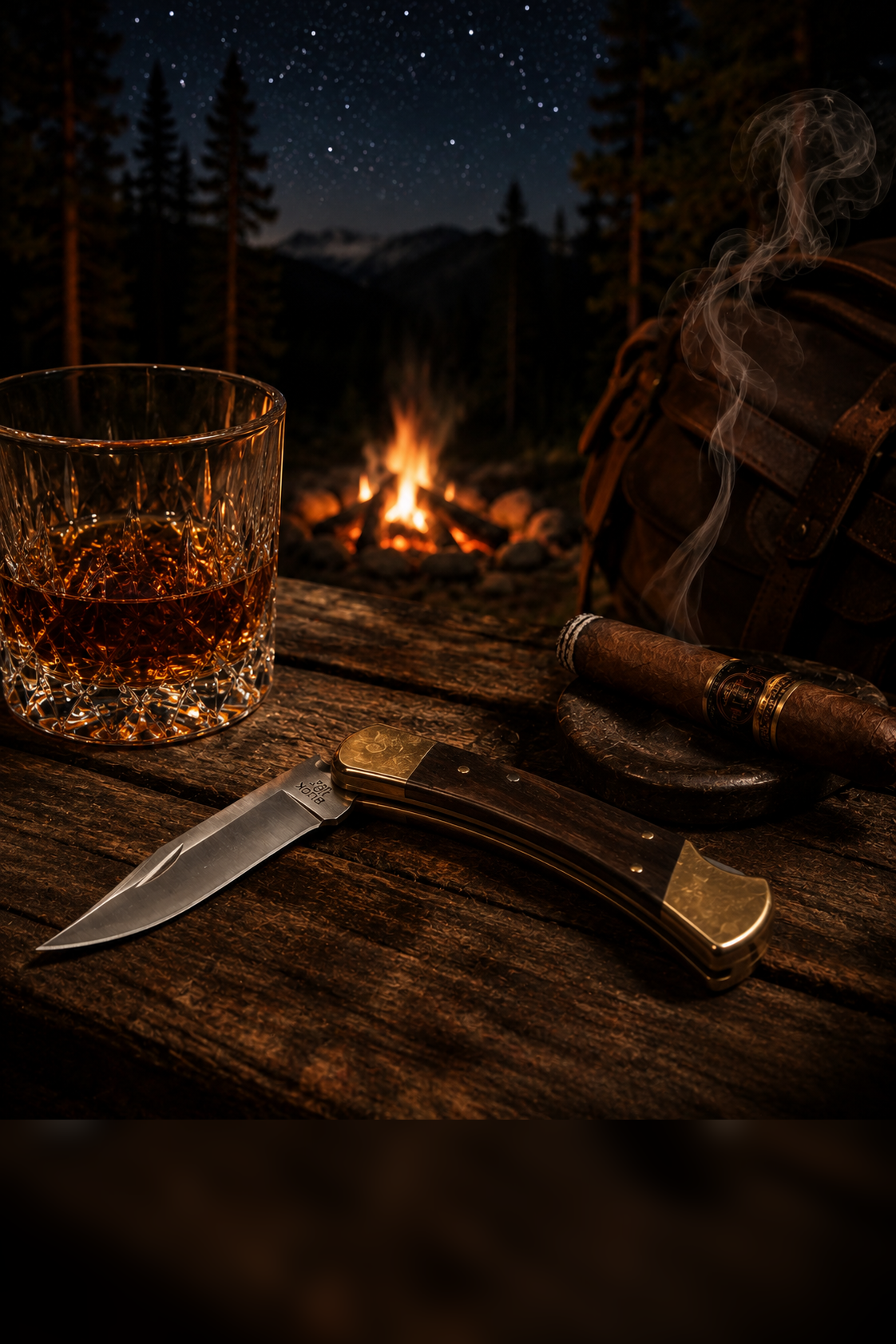
Al Buck built the 110 Folding Hunter in 1963 because he was tired of hunters choosing between a folding knife that was safe to carry and a fixed blade that actually held up. His answer was a lockback mechanism strong enough to trust like a fixed blade, in a body that folded down to fit a belt sheath instead of a boot. Buck’s own account of it is blunt: within six months of release, it was the best-selling knife in the industry. Sixty-two years later, the base model on buckknives.com today still runs the same blueprint — brass bolsters, wood handle scales, that exact lockback — even though the blade steel itself has actually been revised twice since.
What Made It Different in 1963
Before the 110, “folding knife” and “reliable” didn’t really belong in the same sentence for serious outdoor use — slip joints could close on your hand under pressure, and nobody was locking a folder open with confidence. Al Buck’s lockback solved that with a spring-loaded bar running the length of the handle that catches the base of the blade and holds it rigid until you press the release at the back. It’s not a clever gimmick; it’s the reason the 110 spawned an entire category of “folding hunters” that other knife makers spent the next few decades trying to copy.
The Actual Knife
Buck’s current spec sheet for the 110 (SKU 0110) keeps the core blueprint intact: a 3-3/4″ clip-point blade, lockback design, brass bolsters, and genuine ebony handle scales, folding down to a 4-7/8″ closed length and weighing 7.2 oz. It ships with a black leather belt sheath, made in the USA, backed by Buck’s lifetime “Forever” warranty.
Two honest asterisks on the “unchanged” framing, both worth knowing before you buy: the steel itself has moved twice. The original 1963 blade ran 440C stainless; Buck switched to 425M in 1981 for easier sharpening and manufacturing, then settled on today’s 420HC in 1993, where it’s stayed for over 30 years. And the ebony isn’t from the exact same source either — Buck moved from Macassar ebony to sustainably sourced Crelicam ebony in 1994 after Macassar became difficult to source responsibly. The silhouette and the lockback mechanism are the real constant; the materials underneath have been quietly updated more than once, for legitimate reasons each time.
420HC is worth being straight about too: it’s a fine, easy-to-sharpen stainless steel, not a modern supersteel, and Buck isn’t pretending otherwise — they run their own proprietary heat treat on it rather than chasing a premium-steel price tag. If you’re comparing spec sheets against a $200 titanium-and-M390 flipper, the 110 will look plain. That’s not really the comparison this knife is asking for.
What It Costs, and Where to Actually Get It
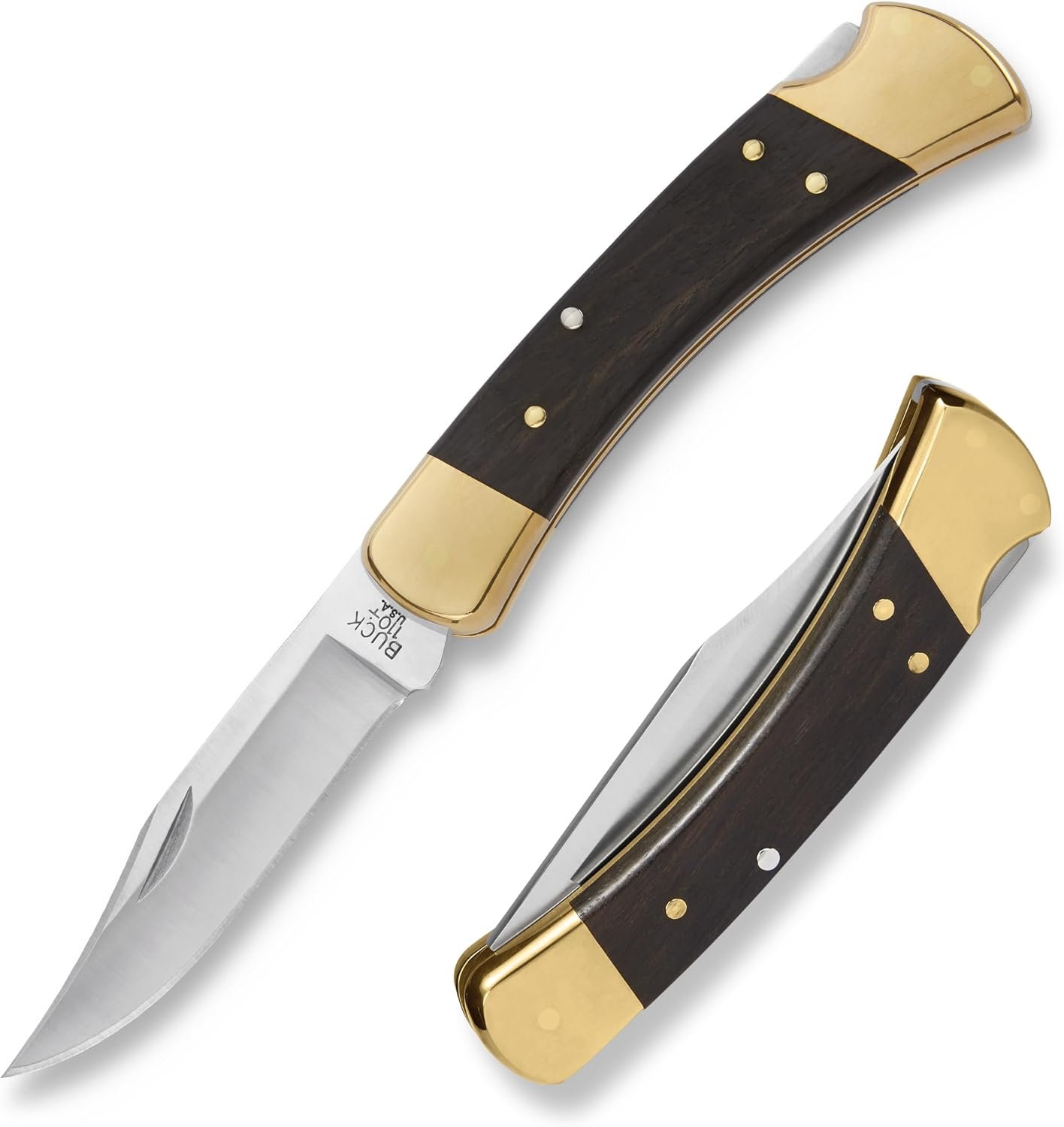
Direct from buckknives.com, the standard 110 Folding Hunter with leather sheath is $89.99, confirmed live on the manufacturer’s own product page as of today (2026-08-30) — in stock, no backorder flag. Buck’s own listing also shows a 4.9-star average across 64 ratings, for whatever that’s worth on a manufacturer’s own site.
The knife is also genuinely listed on Amazon under the exact same spec — brass bolsters, ebony handles, 3-3/4″ 420HC clip point, leather sheath included — at amazon.com/dp/B000EHYZKK. Amazon blocks automated price scraping, so we can’t pull their live number directly, but KnifeCenter had the identical spec knife listed at $89.99 in a recent check, which tracks with Buck’s own direct price rather than diverging from it — a real, useful signal, but still worth a manual glance at the live Amazon price before you buy. One flag worth knowing: there’s a second active Amazon listing for what looks like the same physical knife (a duplicate buy-box situation, not a different product), and a third listing that looks similar in the search results but is actually the 110 Slim Select — a different, nylon-handled knife, not the brass-and-ebony original. If a listing doesn’t say ebony and brass bolsters specifically, it’s not this knife.
The Take
The honest pitch for the 110 isn’t “best knife you can buy in 2026” — on pure steel performance, a lot of $90 modern folders will out-edge-hold it. The pitch is that this exact combination of brass, ebony, and a lockback that just works has been good enough to survive over six decades with the same silhouette and two quiet steel updates, not zero changes, which is still a claim almost nothing else in a pocket can make. It’s the knife that made “folding hunter” a category other companies have spent fifty years trying to copy, and it still does the job it was built for without needing a redesign to justify the price. If you want a knife that looks and feels like it’s from another era because it basically is one, this is the one to buy — not the closest modern equivalent to it.